Research

Making a bedside signal tell the truth about the kidney.

The kidney is among the first organs to suffer when perfusion falls, and among the hardest to monitor in real time. My research builds the sensing hardware, the physics, and the algorithms needed to read renal oxygenation reliably at the bedside, and to turn that reading into earlier detection of acute kidney injury.

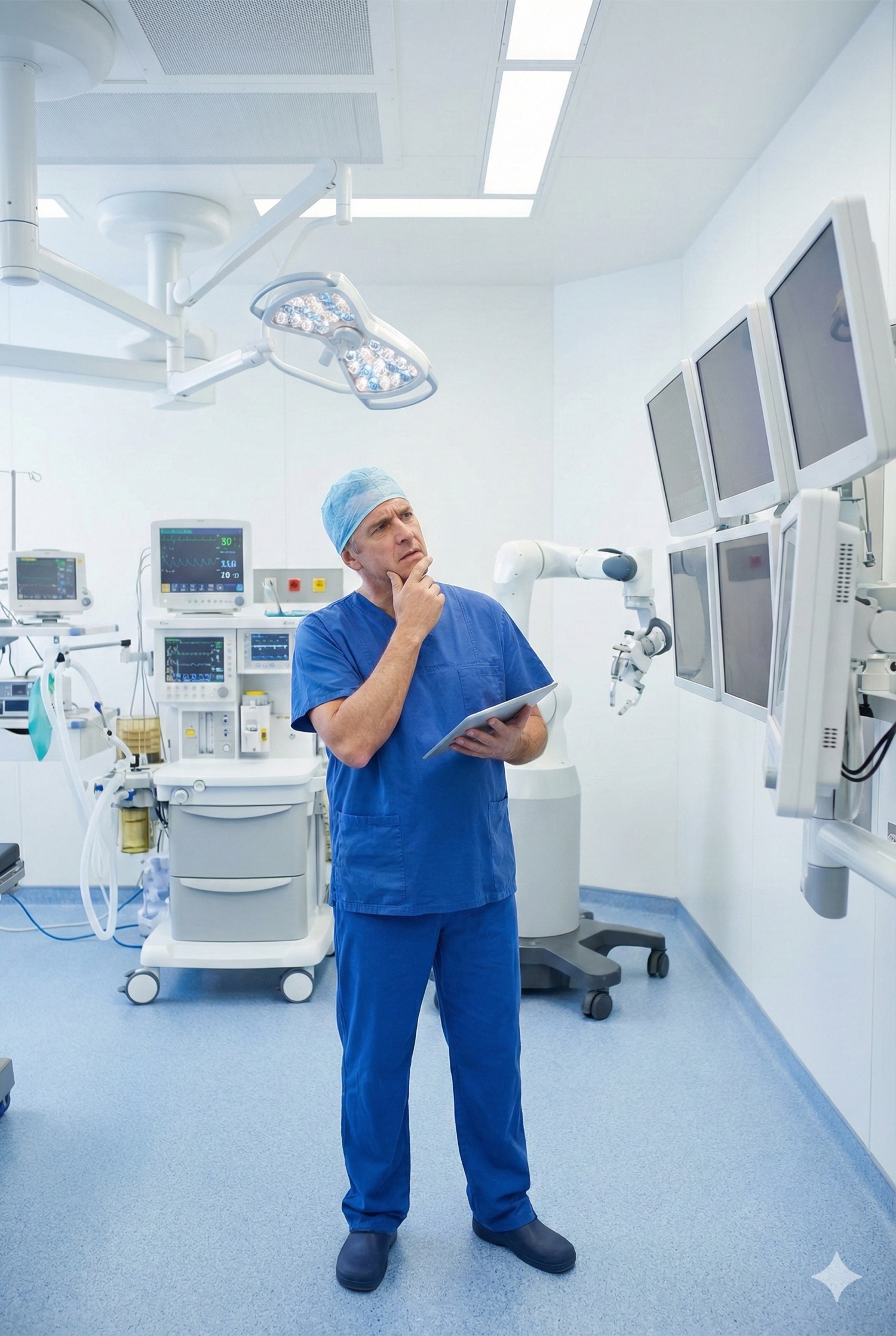
Clinician in scrubs in an operating room surrounded by monitors and anesthesia equipment
Designed for the realities of the operating room and the intensive care unit.
01

Renal Oxygenation Monitoring

Urinary oxygen tension offers a near-real-time window into kidney oxygenation, but only if the signal can be trusted. I develop the measurement chain and correction methods that turn raw urinary PO₂ into a faithful reflection of renal perfusion.

Why it matters
Continuous, organ-level oxygenation could expose hypoperfusion long before conventional markers respond.
Approach
Catheter-based sensing paired with diffusion correction and physics-based modeling of the collecting system.
Setting
Cardiac surgery and critical care, where renal risk is high and monitoring is sparse.
02

Acute Kidney Injury Detection

AKI is common after cardiac surgery and frequently diagnosed only after the kidney has already been harmed. I work on physiology-driven indicators that surface risk earlier than serum creatinine, which lags injury by hours to days.

Why it matters
Earlier signals create a window to intervene before injury becomes established.
Approach
Linking urinary oxygen and transit-time features to AKI risk after cardiac surgery.
Evidence
Systematic review and meta-analysis of AKI risk factors in CABG surgery (protocol under review).
03

Urinary Oxygen Sensing & Catheter-Based Monitoring

Bedside urinary oximetry only works if the sensor is fast, well-calibrated, and reading fresh urine. I develop catheter-integrated sensing together with calibration and sample-validity methods that make the measurement practical in the operating room and ICU.

Why it matters
Pooled or stale urine corrupts the reading; the sensor must know what it is actually measuring.
Approach
Rapid gas-phase calibration of fluorescence-quenching oximeters and transit-time sample validation.
Output
Methods that shorten calibration and flag invalid samples in real time.
04

Medical Device Design & Prototyping

Each project is carried from concept through CAD, prototyping, and bench validation. The throughline is designing for the realities of clinical workflow, not just the physics of the bench.

Toolset
SOLIDWORKS, Fusion 360, ANSYS, Abaqus; Arduino/microcontroller electronics; 3D printing and rapid prototyping.
Approach
Iterate quickly on physical prototypes, validate against laboratory references, refine toward the clinic.
Track record
Inventor on multiple U.S., international, and national patents across medical devices.
05

Signal Processing & Algorithm Development

Most of the difficulty in bedside monitoring is separating physiological signal from artifact. I design algorithms (transit-time tracking, diffusion correction, and sample-validity models) that recover the underlying physiology from noisy measurements.

Methods
Model-based correction, transit-time distribution analysis, and laboratory-validated estimation.
Implementation
Python and MATLAB pipelines tied to bench and animal-model data.
Result
Improved AKI discrimination from signals that were previously too noisy to use.
06

Translational Healthcare Innovation

Engineering only matters clinically if it reaches patients. I work to move technologies across the gap, through intellectual property, clinical collaboration, and translational programs such as MIT Catalyst.

Collaboration
Bridging engineering, anesthesiology, and critical care with clinician partners.
Pathways
MIT Catalyst Fellowship; patent filings; AI-assisted clinical tools such as Medistant.
Goal
Technologies that change decisions at the bedside, not just measurements on a bench.

See the work in practice.

Featured projects detail the problems, methods, and clinical potential behind each research thread.